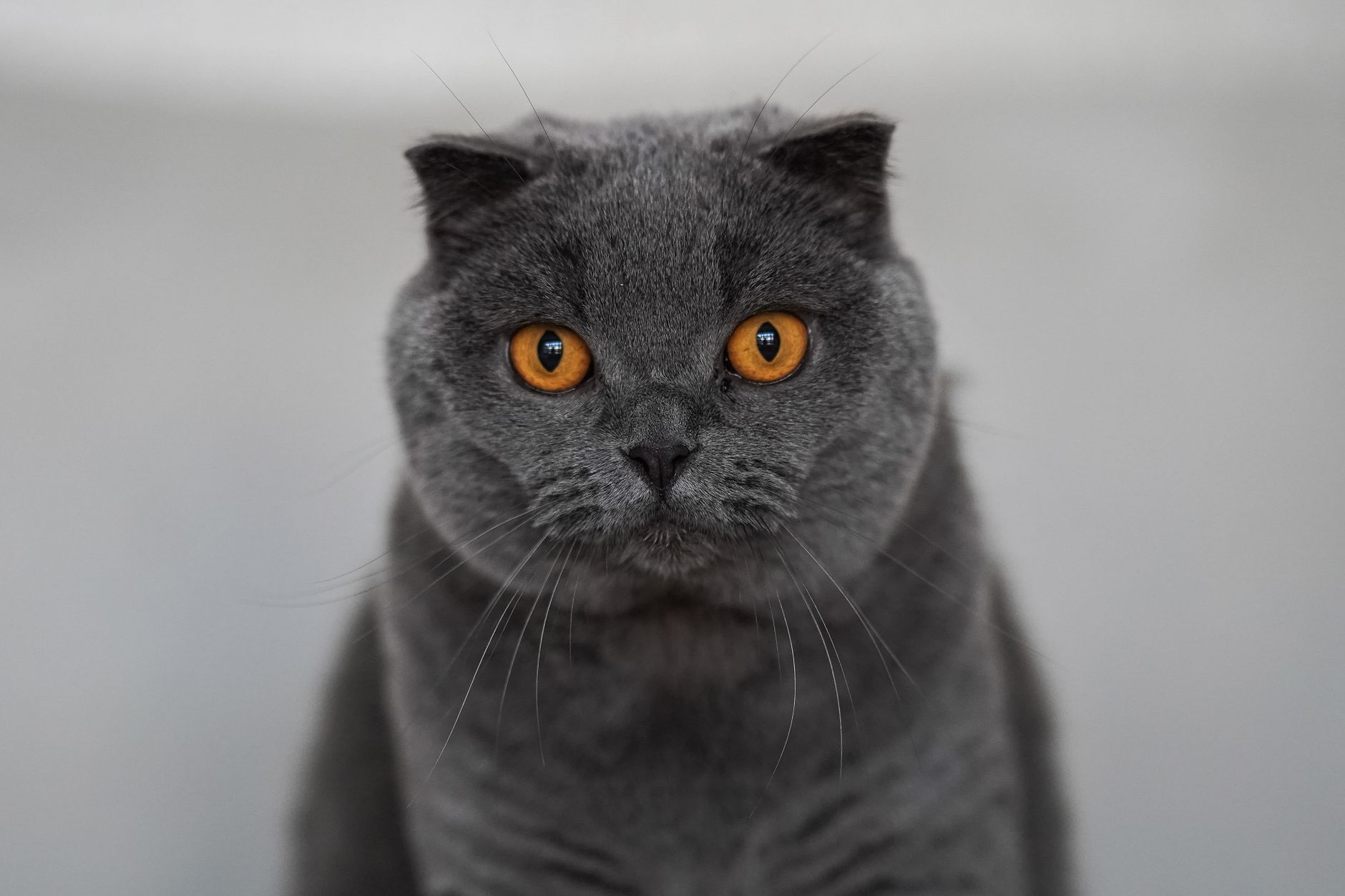
In short: The Scottish Fold is a small-to-medium cat breed known for the ears that fold forward and down against its head, giving it a round, owl-like face. Sweet-natured, calm, and quiet, Folds weigh 6–13 pounds, live about 11–15 years, and cost $1,000–$3,000 as kittens. The same gene that folds their ears also affects cartilage throughout the body — a fact that makes this one of the most beautiful and most ethically debated cats in the world.
If you’re researching a Scottish Fold kitten, this guide answers everything American owners ask: temperament, lifespan, price, grooming, and — most importantly — an honest, veterinary-grounded look at the health problems every Fold carries, why some cat registries ban the breed, and how to adopt one responsibly if you choose to.

Scottish Fold Breed Info Card
| Trait | Scottish Fold |
|---|---|
| Weight | Males 9–13 pounds; females 6–9 pounds |
| Height | 8–10 inches at the shoulder |
| Lifespan | 11–15 years |
| Coat | Short or long (the longhaired variety is called the Highland Fold); dense and plush |
| Colors | Nearly all colors and patterns — solid, tabby, calico, bicolor, colorpoint |
| Temperament | Sweet, calm, affectionate, quiet, people-oriented |
| Signature trait | Forward-folded ears (kittens are born straight-eared; ears fold at 3–4 weeks in affected kittens) |
| Origin | Tayside, Scotland — 1961 |
| Registry status | Recognized by CFA and TICA (US); NOT recognized by GCCF (UK) or FIFe (Europe) |
| Kitten price (US) | Roughly $1,000–$3,000; rare colors and lineages higher |
- Affection / cuddliness
- Energy level
- Vocalness
- Grooming needs
- Good with kids
History: Susie the Barn Cat and the Fold That Started It All
Every Scottish Fold alive today traces back to a single white barn cat named Susie, discovered in 1961 on a farm in Tayside, Scotland. Susie had an unusual mutation: her ears folded forward and down, giving her a rounded, almost owl-like silhouette. A neighboring farmer and cat fancier, William Ross, was captivated. When Susie had kittens, two carried the folded ears, and Ross — with his wife Mary — began a careful breeding program with the help of geneticists to understand what they were seeing.
The breed was originally called the “lop-eared” cat before settling on the name Scottish Fold. Early breeders crossed Folds with British Shorthairs and American Shorthairs to build a healthy gene pool, which is why the Fold still shares the round face and sturdy body of its British Shorthair cousins. The breed reached the United States in 1971, and the Cat Fanciers’ Association (CFA) granted full recognition in 1978. Today the American registries CFA and TICA both accept it.
But the breed’s home country never embraced it. Britain’s Governing Council of the Cat Fancy (GCCF) stopped registering Scottish Folds in the early 1970s over health concerns, and Europe’s Fédération Internationale Féline (FIFe) has never recognized the breed at all. That split — celebrated in America, banned where it was born — is the thread running through the Scottish Fold’s entire story, and we’ll return to why in detail below.
The Folded Ears, Explained
Here’s something most people don’t know: Scottish Fold kittens are not born with folded ears. Every Fold kitten arrives with normal, straight, pointed ears. Then, at around three to four weeks of age, the ears of affected kittens begin to fold forward and down. Kittens whose ears never fold are called “Straights” (Scottish Straights) — they carry the family lines but not the visible trait.
The fold is caused by a single dominant gene, often written Fd, that disrupts the normal development of cartilage. Because it’s dominant, a kitten only needs one copy to have folded ears. The degree of fold varies: a “single fold” gives a loose, relaxed bend, while “double” and “triple” folds press the ears tight and flat against the skull — the look most prized in the show ring. That tighter fold is also, as we’ll see, a marker of more severe cartilage change.
The Scottish Fold is the most famous fold-eared cat, but it isn’t the only one. The longhaired version is the Highland Fold. Crosses have produced the American Curl (a separate mutation that curls ears backward, not forward) and hybrids like the Foldex and the Munchkin-crossed “Scottish Kilt.” Any cat with genuinely folded-forward ears descends from that same Scottish cartilage mutation — there is no other natural source of the trait in domestic cats.

The Ethical Controversy: Why the Fold Gene Is a Cartilage Disorder
This is the section responsible sources leave out, and it’s the single most important thing to understand before you fall in love with a Scottish Fold. The gene that folds the ears does not act only on the ears. It causes a condition called osteochondrodysplasia — often abbreviated SFOCD, for Scottish Fold Osteochondrodysplasia — a developmental disorder of cartilage and bone that affects the whole skeleton.
The ears fold because the cartilage in them can’t hold its normal shape. That same faulty cartilage sits in the joints — especially the ankles, knees, and tail. Over time it forms abnormal bone, fuses joints, and produces painful, degenerative arthritis. Studies using X-rays have found that every Scottish Fold shows some degree of these skeletal changes, even cats that look and move normally. The folded ear is not a cute quirk sitting on top of an otherwise healthy cat — it is the one visible sign of a body-wide condition.
Signs of SFOCD include a stiff or stubby, inflexible tail, reluctance to jump, an abnormal or stilted gait, lameness, swollen or thickened lower legs, and — in severe cases — cats so crippled by fused joints that walking becomes painful. Because the disease is progressive, a kitten that seems fine at twelve weeks may develop obvious arthritis by middle age. There is no cure. Treatment is limited to managing pain with anti-inflammatories, joint supplements, and in some cases radiation therapy or surgery to relieve the worst joints.
The severity is worst when a cat inherits two copies of the fold gene — the result of breeding one Fold to another Fold (fold × fold). These homozygous cats often develop crippling arthritis young. That’s why ethical breeders never breed two Folds together; they pair a folded-ear cat with a straight-eared cat (a Scottish Straight, British Shorthair, or American Shorthair) so no kitten gets a double dose. But — and this is the hard truth — even a single copy still causes disease. Breeding to a Straight reduces the severity; it does not eliminate it.
This is why the GCCF and FIFe refuse to register the breed, why the British Veterinary Association and numerous veterinary bodies have publicly called for an end to Fold breeding, and why countries including Scotland have debated banning it outright. In 2021, a proposal to ban Scottish Fold breeding advanced in their country of origin. Many veterinarians consider the breed a textbook example of a “conformation” — a physical trait humans find appealing — being selected at the direct cost of the animal’s welfare. We’re not telling you what to feel about that. We’re telling you the folded ears you’re paying for are a genetic bone-and-joint disease, so that whatever you decide, you decide it with your eyes open.
Scottish Fold Temperament and Personality
Setting the health questions aside for a moment, it’s easy to see why people adore this breed’s personality. The Scottish Fold temperament is famously sweet, gentle, and easygoing. These are calm, affectionate cats that bond closely with their people and want to be wherever you are — not necessarily on you every second, but in the same room, supervising. They adapt well to families, other cats, and even cat-friendly dogs.
Folds are also notably quiet, “talking” in soft chirps and trills rather than the loud yowling of a Siamese — a trait that makes them popular with apartment dwellers. And yes, Scottish Folds love to cuddle. They’re consistently ranked among the more affectionate, lap-friendly breeds, though like all cats, individual personalities vary.
The breed is best known for its bizarre and endearing sitting postures. Folds famously sit upright on their haunches with their front paws resting on their belly — the so-called “Buddha sit” or “owl pose” — and sprawl flat on their backs in ways that look almost human. Owners find it adorable. It’s worth knowing, though, that some behaviorists suspect these poses may sometimes be a way to relieve pressure on aching joints and a stiff tail, another reason to keep an eye on comfort even when the pictures are cute.
Scottish Fold Health Problems
⚠️ See a veterinarian promptly if your Scottish Fold shows:
- A stiff, thickened, or immobile tail — reluctance to let you touch it, or a tail that no longer curves normally, is an early sign of osteochondrodysplasia.
- Reluctance to jump, limping, or an abnormal “walking on eggshells” gait — signs of joint pain or arthritis, even in a young cat.
- Swollen, enlarged, or misshapen lower legs and ankles — abnormal bone growth around the joints.
- Rapid breathing, open-mouth panting, lethargy, or sudden hind-limb weakness — possible signs of hypertrophic cardiomyopathy (HCM) or a blood clot, a veterinary emergency.
- Increased thirst and urination or weight loss — possible polycystic kidney disease (PKD) or other kidney trouble.
The defining health problem of the breed is the skeletal disease described above — every Scottish Fold carries some degree of osteochondrodysplasia, and it deserves lifelong attention from you and your vet. Ask your veterinarian about baseline X-rays, and don’t dismiss “clumsiness” or a stiff tail as personality quirks. Pain management started early makes a real difference to quality of life.
Beyond the cartilage disorder, Scottish Folds share a few inherited conditions with their British Shorthair and Persian relatives that responsible breeders screen for:
- Hypertrophic cardiomyopathy (HCM). The most common feline heart disease, in which the heart muscle thickens and eventually fails. It can strike young cats with no warning. Reputable breeders screen breeding cats by echocardiogram and, where available, DNA test. Ask for the results.
- Polycystic kidney disease (PKD). An inherited condition causing fluid-filled cysts in the kidneys that can lead to kidney failure. A simple DNA test identifies carriers, so no responsible breeding cat should pass it on.
- Osteoarthritis and joint fusion. The downstream result of SFOCD — chronic, progressive, and painful. Weight control and joint support are central to managing it.
- Ear-related issues. The tight fold can trap wax and moisture, so Folds need regular ear checks. Contrary to a common myth, folded ears do not make cats deaf or unusually prone to mites, but the reduced airflow does warrant routine cleaning.
This article is informational and does not replace an exam by a licensed veterinarian. If you suspect a health problem, consult your vet.
Scottish Fold Lifespan
A Scottish Fold typically lives 11–15 years, roughly average for a purebred cat. Many reach the upper end of that range with attentive care. The breed’s life expectancy isn’t dramatically shortened by the fold gene — but its quality of life can be, because the associated arthritis tends to worsen with age. The goal for a Fold owner isn’t just a long life; it’s a comfortable one. Keeping your cat lean, providing soft bedding and low-effort access to favorite perches (steps or ramps instead of high leaps), and staying ahead of joint pain with your vet all help a Fold age gracefully.

Grooming a Scottish Fold
Grooming is one of the easier parts of Fold ownership. The shorthaired Scottish Fold needs a weekly brush to remove loose hair and keep the dense coat healthy; the longhaired Highland Fold needs brushing two or three times a week to prevent mats, especially around the ruff and britches. Both shed moderately year-round with heavier seasonal shedding.
The ears need special attention. Because the fold restricts airflow and can trap wax and debris, check them weekly and gently clean the outer ear with a vet-approved solution when you see buildup — never insert anything into the ear canal. Round out the routine with regular nail trims, and because Folds (like Persians and British Shorthairs) are prone to dental disease, brush their teeth several times a week with a cat-specific toothpaste. Handle the tail gently during grooming; a Fold with early skeletal changes may find a stiff tail tender to the touch.
Feeding a Scottish Fold
Feed a Scottish Fold a high-quality cat food that meets AAFCO standards for its life stage, with named animal protein as the first ingredient. Two priorities stand out for this breed. First, weight control is a joint issue: every extra ounce adds load to already-compromised joints, so keeping your Fold lean is one of the most effective things you can do for its arthritis. Second, many owners work joint-supporting nutrients — omega-3 fatty acids, glucosamine, and chondroitin — into the diet under veterinary guidance.
- Kittens: feed a kitten formula in several small meals a day through the first year to support steady growth.
- Adults: two measured meals a day; monitor body condition and adjust portions rather than free-feeding, which invites obesity in this laid-back breed.
- Hydration: because the breed is prone to kidney disease, encourage water intake with a pet fountain and consider incorporating wet food.
- Body condition: you should be able to feel the ribs easily and see a slight waist from above. A pudgy Fold is a Fold in more pain than it needs to be.
Is a Scottish Fold Right for You?
🐾 Who this breed suits
- People who want an affectionate lap cat
- Quiet homes & apartments
- Families with gentle children
- Owners ready for lifelong joint care & vet costs
- Buyers unwilling to vet a breeder carefully
- Anyone uneasy about knowingly buying a genetic disorder
Consider a Scottish Fold if: you want a calm, cuddly, quiet companion, you’re financially and emotionally prepared for the near-certainty of lifelong joint care, and — critically — you will buy only from a breeder who health-tests for HCM and PKD and never breeds fold to fold. A responsible Fold breeder pairs a folded cat with a straight-eared one, screens the parents, and will talk openly about the breed’s skeletal disease. If a breeder dismisses the health concerns or advertises “fold-to-fold” litters for that extra-tight ear look, walk away.
Look at other breeds if: you’re not comfortable knowingly bringing home a cat that carries a painful cartilage disorder, or you can’t commit to the veterinary attention it will need. The British Shorthair delivers nearly identical looks and personality — that round face, that plush coat, that mellow temperament — with normal ears and none of the fold-linked disease. It is, honestly, the kinder version of the same cat.
Scottish Fold Kittens, Price, and Rescue

How much does a Scottish Fold cat cost? From a reputable US breeder, a Scottish Fold kitten typically costs $1,000–$3,000, with pet-quality kittens usually in the $1,000–$2,000 range and show- or breeding-quality cats, rare colors, and tightly folded ears pushing toward $3,000 and beyond. The viral headlines about a “$20,000 cat” refer to exceptional show or breeding lines and are not what an ordinary buyer pays. Beyond the purchase price, budget for lifelong care — quality food, litter, insurance, and the arthritis-related vet costs that most Folds eventually incur — which realistically adds $800–$1,800 a year.
A quick word on the Munchkin Scottish Fold cross. Breeding a Scottish Fold to a Munchkin (itself a cat with a cartilage/bone mutation causing short legs) produces short-legged, fold-eared kittens sold under names like “Scottish Kilt,” “Genetta,” or “Napoleon/Minuet.” Stacking two separate skeletal mutations in one cat compounds the welfare problems, and most veterinarians and mainstream registries strongly discourage these crosses. Cute as they look online, they represent the extreme end of breeding for appearance over health.
Consider rescue. Scottish Folds do end up in shelters and breed-specific rescues, often surrendered when arthritis sets in and vet bills mount. Adopting an adult Fold — through a general shelter, Petfinder, or a purebred rescue — costs a fraction of a breeder price (typically $75–$300), gives you a cat with a known temperament, and doesn’t create demand for more breeding. For many prospective owners who love the breed but are uneasy about buying into it, adoption is the most ethical path to a Fold of your own.
Frequently Asked Questions
How expensive is a Scottish Fold cat?
A Scottish Fold kitten from a reputable US breeder generally costs $1,000–$3,000. Pet-quality kittens run about $1,000–$2,000, while show-quality cats, rare colors, and tightly folded ears reach $3,000 or more. Factor in $800–$1,800 a year for food, litter, insurance, and the joint-related veterinary care most Folds eventually need.
What are the negatives of Scottish Folds?
The biggest negative is health: the gene that folds the ears causes osteochondrodysplasia, a cartilage and bone disorder that affects every Scottish Fold to some degree and often leads to painful arthritis. Folds are also prone to HCM heart disease and PKD kidney disease, and the breed is banned by several cat registries on welfare grounds.
Do Scottish Folds have ear problems or pain?
The folded ears themselves aren’t painful, but the tight fold restricts airflow and can trap wax, so they need regular cleaning. The real concern is body-wide: the same cartilage defect causes joint disease, especially in the tail and hind legs. Watch for a stiff tail, reluctance to jump, or an odd gait, and see your vet.
Is a Scottish Fold cat a good pet?
Temperament-wise, yes — Scottish Folds are sweet, calm, quiet, and affectionate, and they adapt well to families and apartments. The caveat is health: you’re taking on a cat with a genetic skeletal disorder that will likely need lifelong joint care. A good pet for the right, well-informed owner who buys or adopts responsibly.
Why are Scottish Folds banned in some countries?
Registries including the UK’s GCCF and Europe’s FIFe refuse to recognize the breed because the fold-ear gene is inseparable from osteochondrodysplasia, a painful cartilage disorder. Veterinary organizations argue it’s unethical to deliberately breed cats that carry a skeletal disease purely for appearance. Scotland, the breed’s birthplace, has debated banning Fold breeding entirely.
Do Scottish Folds like to cuddle?
Yes. Scottish Folds are among the more affectionate cat breeds and typically enjoy cuddling, lap time, and staying close to their people. They tend to be gentle and undemanding about it rather than clingy, following you room to room and settling nearby. As with any cat, individual personalities vary.
Are Scottish Fold kittens born with folded ears?
No. All Scottish Fold kittens are born with straight, pointed ears. In kittens that inherit the fold gene, the ears begin to fold forward at about three to four weeks of age. Kittens whose ears stay upright are called Scottish Straights and don’t develop the folded look, though they carry the family lineage.
How long do Scottish Fold cats live?
Scottish Folds typically live 11–15 years, about average for a purebred cat. The fold gene doesn’t drastically shorten lifespan, but the associated arthritis can reduce quality of life with age. Keeping your Fold at a healthy weight, easing its access to perches, and managing joint pain early all help it stay comfortable into its senior years.
Related Breeds
If the Scottish Fold’s looks or personality drew you in, these related cats are worth exploring in our cat breeds hub:
- British Shorthair — the Fold’s closest relative and a foundation of the breed; the same round face, plush coat, and mellow temperament, with normal ears and none of the fold-linked disease.
- Munchkin — the short-legged breed sometimes crossed with Folds; charming but itself the subject of skeletal-health debate, and best understood before considering any “Scottish Kilt” hybrid.
- Browse all cat breeds — compare temperament, grooming, and health across dozens of breeds to find your best match.
Sources: Cat Fanciers’ Association (CFA), International Cat Care, University of Edinburgh Royal (Dick) School of Veterinary Studies, Merck Veterinary Manual, and published veterinary literature on Scottish Fold osteochondrodysplasia — consulted for facts only. All text is original.
This article is for informational purposes and does not replace an examination by a licensed veterinarian.
