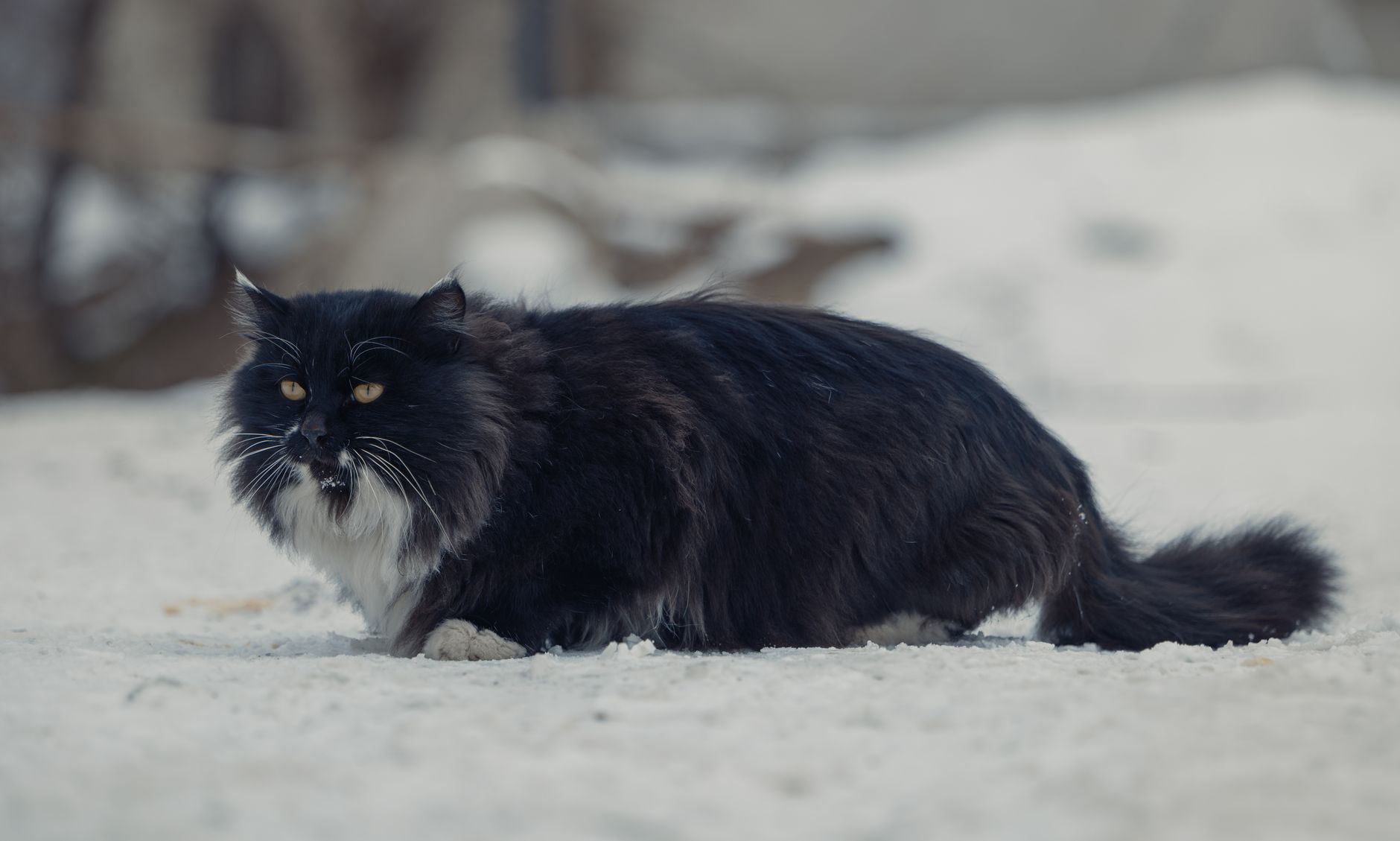
In short: The Norwegian Forest Cat is a large, sturdy longhaired cat breed from Norway, with adult males weighing 12–16 pounds and a thick, water-resistant double coat built for Scandinavian winters. Nicknamed the “Wegie,” this gentle, patient, family-friendly cat is intelligent and quietly affectionate — a devoted companion that bonds deeply without demanding constant attention.
Often confused with the Maine Coon, the Norwegian Forest Cat (or “skogkatt” in Norwegian) is a natural breed shaped by centuries of survival in harsh forests. This guide covers everything American owners ask: personality, size, coat colors, health, grooming, kitten prices from reputable breeders, and how the “NFC cat” compares to its look-alike cousins.

Norwegian Forest Cat Breed Info Card
| Trait | Norwegian Forest Cat |
|---|---|
| Weight | Males 12–16 pounds; females 8–12 pounds |
| Height | 9–12 inches at the shoulder |
| Length | Up to 12–18 inches body length, plus a long bushy tail |
| Lifespan | 14–16 years |
| Coat | Long, dense, water-resistant double coat with a woolly undercoat |
| Colors | Nearly every color and pattern except pointed (Siamese-style); brown tabby, black, white, grey, and orange (red) are common |
| Temperament | Gentle, calm, friendly, intelligent, moderately playful |
| Origin | Norway — a natural landrace breed centuries old |
| Shedding | High, with heavy seasonal shedding in spring and fall |
| Kitten price (US) | Roughly $800–$2,500 from reputable breeders |
- Affection level
- Energy level
- Intelligence
- Shedding
- Good with kids
- Good with other pets
- Vocality
- Grooming needs
History: Norway’s Ancient Forest Cat
The Norwegian Forest Cat is a genuinely old, naturally occurring breed — not a modern creation of the show ring. In Norway it is called the skogkatt, literally “forest cat,” and it appears in Norse mythology and Scandinavian folktales stretching back many centuries. Legend holds that these cats pulled the chariot of the goddess Freya and that the ship cats of the Vikings were the breed’s ancestors, carried across the North Atlantic to hunt rodents and possibly seeding related longhaired cats elsewhere.
What is not legend is the environment that shaped this cat. For hundreds of years, semi-wild forest cats survived Norway’s brutal winters on farms and in the woods, and natural selection did the breeding. The result is a rugged, cold-hardy animal: a dense water-resistant double coat, tufted “snowshoe” paws, ear and toe tufts, and the strength to climb rock faces and tall trees. The Wegie is famous as a skilled climber — some can descend headfirst.
By the early 20th century, cross-breeding with domestic shorthairs nearly diluted the landrace out of existence. Norwegian cat fanciers began a deliberate preservation effort in the 1930s, interrupted by World War II and revived in the 1970s. King Olav V designated the skogkatt Norway’s official national cat. The breed reached the United States in 1979, earned Cat Fanciers’ Association (CFA) championship status in 1993, and remains a beloved, if still relatively uncommon, breed among American cat lovers.
Norwegian Forest Cat vs. Maine Coon (and Siberian)
The single most common question about this breed is how to tell a Norwegian Forest Cat apart from a Maine Coon, and where the Siberian cat fits in. All three are big, longhaired, cold-weather “natural” breeds that look strikingly similar at a glance. Here’s how they actually differ.
| Norwegian Forest Cat | Maine Coon | Siberian | |
|---|---|---|---|
| Adult male weight | 12–16 lbs | 13–18 lbs (often larger) | 10–17 lbs |
| Head shape | Equilateral triangle, straight profile | Wedge with high cheekbones, squared muzzle | Rounded, modified wedge |
| Body | Long, muscular, athletic | Long, rectangular, rangy | Compact, barrel-chested, dense |
| Coat | Smooth, water-resistant, woolly undercoat | Silky, shaggy, uneven length | Triple coat, very dense |
| Ears | Lynx tips common, heavy furnishings | Large, wide-set, lynx tips | Medium, rounded, tufted |
| Personality | Calm, independent, gentle | Playful, “dog-like,” very social | Playful, affectionate, agile |
So which is bigger — a Maine Coon or a Norwegian Forest Cat? On average the Maine Coon edges it out and holds the records for the world’s longest domestic cats, but a large male Wegie overlaps completely with a mid-sized Maine Coon. The most reliable tell is the head: the Norwegian Forest Cat has a clean equilateral triangle with a straight profile running from the brow to the nose, while the Maine Coon shows high cheekbones, a squared muzzle, and often a slight nose curve. If you want certainty, ask the breeder for pedigree papers.

Norwegian Forest Cat Personality and Family Life
The Norwegian Forest Cat personality is best summed up as gentle, mellow, and quietly devoted. This is not a needy or loud cat. Wegies bond strongly with their families and like to be in the same room as their people, following you from kitchen to couch, but they are content to supervise from a nearby perch rather than sprawl across your keyboard. Many owners describe them as friendly and patient without being clingy — an ideal balance for people who want companionship that respects their space.
Are Norwegian Forest Cats good with kids and other pets? Yes, and this is one of the breed’s greatest strengths. Their calm, tolerant nature and sturdy build make them excellent with respectful children, and they generally coexist happily with dogs and other cats. The breed’s laid-back confidence means it rarely startles or lashes out, which is why so many families with a full household choose a Wegie.
Do Norwegian Forest Cats like being held? As a rule, they enjoy affection on their own terms more than being scooped up and cradled. Most Wegies prefer to sit beside you, lean into a chin scratch, or curl up in your lap by choice rather than be picked up and restrained — a common trait in large, dignified breeds. Respect that preference and you’ll earn a loyal shadow. The breed is only moderately vocal, communicating with soft chirps and trills rather than the constant commentary of a Siamese.
Don’t mistake calm for lazy, though. The Norwegian Forest Cat is an athletic climber and hunter at heart. Give it tall cat trees, sturdy shelves, and window perches, and you’ll see the forest cat come out — scaling to the highest point in the room and watching over its domain like the tree-climbing woodland cat it was bred to be.
Size: How Big Do Norwegian Forest Cats Get?
The Norwegian Forest Cat is one of the larger domestic cat breeds. Adult males typically weigh 12–16 pounds, with some big, well-grown toms reaching 18–20 pounds, while females are noticeably smaller at 8–12 pounds. Expect a body length around 12–18 inches plus a long, plumed tail that can be nearly as long as the body, and a shoulder height of roughly 9–12 inches.
One thing that surprises new owners: this is a slow-maturing breed. Where most cats reach full size by one year, the Norwegian Forest Cat isn’t fully grown until around 4 to 5 years of age. The “giant Norwegian forest cat” look — the broad chest, heavy bone, and full ruff — develops gradually. That long, muscular frame is genuine, not just coat, but the fluffy double coat does add to the impression of size, especially in winter.
Coat Colors and Patterns
Norwegian Forest Cats come in an enormous range of colors and patterns — essentially every combination except the pointed (Siamese-style) coloring, which isn’t part of the breed. The most iconic is the brown classic tabby with white, but the breed spans a striking palette:
- Black Norwegian Forest Cat. A solid black Wegie is dramatic and popular; the dense coat gives it a glossy, almost wolf-like presence. Many “black forest cats” are actually very dark tabbies.
- Orange (red) Norwegian Forest Cat. Warm ginger and red tabbies are common and eye-catching, often with white bibs and paws.
- Grey (blue) Norwegian Forest Cat. Soft grey and blue-tabby coats are prized for their plush, smoky look.
- White, tortoiseshell, calico, and silver. The breed also produces bicolor, tortie, calico, and shaded-silver coats.
What’s the rarest color of Norwegian Forest Cat? Solid colors overall are less common than tabbies, and among them the pure amber and golden shades — a color mutation unique to and first identified in this breed — are considered the rarest and most sought-after. Solid white and true chocolate/cinnamon (which are not accepted in the breed standard) are also uncommon.
Norwegian Forest Cat Health Issues
⚠️ See a veterinarian promptly if you notice:
- Rapid or labored breathing, open-mouth panting, or sudden lethargy — possible sign of hypertrophic cardiomyopathy (HCM), the most common feline heart disease.
- Sudden hind-leg weakness, paralysis, or crying in pain — a possible blood clot (saddle thrombus), a life-threatening emergency linked to heart disease.
- Reluctance to jump or climb, or a stiff, bunny-hopping gait in a young cat — possible hip dysplasia, which occurs in large breeds.
- Increased thirst and urination, or weight loss despite a good appetite — worth a vet check for kidney or metabolic disease.
The Norwegian Forest Cat is a hardy, generally healthy breed — a legacy of centuries of natural selection. Still, like all purebred cats, it has a few inherited conditions responsible breeders screen for, and buyers should ask for the paperwork:
- Hypertrophic cardiomyopathy (HCM). A thickening of the heart muscle and the most significant health concern in the breed. Reputable breeders have breeding cats screened by echocardiogram.
- Glycogen storage disease type IV (GSD IV). A rare but serious inherited metabolic disorder specific to this breed. A reliable DNA test exists, and ethical breeders test to avoid producing affected kittens.
- Hip dysplasia. Malformation of the hip joint that can lead to arthritis; more common in large, heavy-boned breeds than in most cats.
- Polycystic kidney disease (PKD) and retinal issues. Uncommon in the breed but part of a thorough breeder’s screening panel.
- Obesity. Not genetic, but a real risk. A large, calm indoor cat can gain weight easily, which strains joints and the heart.
This article is informational and does not replace an exam by a licensed veterinarian. If you suspect a health problem, consult your vet.
Lifespan
The Norwegian Forest Cat has a life expectancy of about 14–16 years, and well-cared-for indoor cats frequently live into their late teens. Keeping your Wegie indoors (or in a secure catio), feeding a measured, high-quality diet to prevent obesity, staying current on veterinary checkups, and screening for HCM as your cat ages all contribute to a long, comfortable life. This is a breed that ages gracefully, often staying playful and engaged well into its senior years.
Grooming and Shedding
That magnificent double coat is lower-maintenance than it looks — but it is not no-maintenance. The Norwegian Forest Cat’s water-resistant topcoat and woolly undercoat resist matting better than a Persian’s, so a thorough combing two or three times a week is usually enough to keep it healthy and tangle-free. During the two big seasonal sheds in spring and fall, the undercoat comes out in impressive quantities, and daily brushing becomes essential to stay ahead of loose fur and hairballs.
Pay special attention to the “trouser” fur on the hind legs, the ruff around the neck, and the belly and armpits, where mats form first. The coat is often at its fullest in winter and thins noticeably in summer, when Wegies can look almost like a different, shorter-haired cat. Round out grooming with weekly nail trims, regular ear checks, and routine dental care. So yes — Norwegian Forest Cats shed a lot, and this is a breed for people who don’t mind fur on the furniture.

Feeding, Play, and Training
Feed a large, active breed like a large, active breed. Choose a high-quality cat food that meets AAFCO standards for your cat’s life stage, with named animal protein as the first ingredient. Because Wegies grow slowly and get big, kittens benefit from a growth or all-life-stages formula for the first several years. Portion by body condition, not by the bag’s generous suggestions — you should be able to feel the ribs under that coat.
- Diet: measured meals rather than free-feeding help prevent the obesity this calm breed is prone to. Fresh water and, for many cats, some wet food support kidney and urinary health.
- Enrichment: give this intelligent breed vertical space — tall cat trees, wall shelves, and window perches satisfy the climber in them. Puzzle feeders and interactive wand play channel their hunting instincts.
- Training: Wegies are clever and food-motivated. Many happily learn to walk on a harness, fetch, or respond to clicker training, which also provides mental exercise.
- Companionship: they tolerate alone time better than some breeds but do best with a companion animal or an engaged household rather than long, empty days.
Is a Norwegian Forest Cat Right for You?
🐾 Who this breed suits
- First-time cat owners
- Families with children
- Homes with dogs or other cats
- Apartment living
- People who dislike shedding
- Owners wanting a lap-cuddle cat
- Busy owners wanting an independent companion
Get a Norwegian Forest Cat if: you want a large, striking, good-natured cat that gets along with kids, dogs, and other pets; you appreciate a companion who is affectionate but not demanding; and you’re happy to brush a few times a week and vacuum a bit more during shedding season.
Think twice if: you want a low-shedding or hypoallergenic cat, you can’t provide vertical climbing space, or you’re set on a cat that loves being carried and cuddled on demand. Allergy sufferers should note that no cat is truly hypoallergenic, and this breed’s abundant coat sheds heavily.
Norwegian Forest Cat Kittens, Breeders, and Price

How much does a Norwegian Forest Cat cost? From reputable Norwegian Forest Cat breeders in the United States, expect a kitten price of roughly $800–$2,500, with most pet-quality kittens from health-tested parents landing between $1,000 and $1,800. Show- or breeding-quality kittens, rare colors like amber, and cats from imported European lines can run $2,500–$4,000 or more. Budget beyond the purchase price too: quality food, litter, grooming tools, and routine vet care typically add $800–$1,500 per year, with more in the first year for spay/neuter and vaccines.
When you search “Norwegian Forest Cat for sale,” vet the seller carefully. A responsible breeder tests breeding cats for HCM by echocardiogram, DNA-tests for GSD IV, raises kittens underfoot in the home, provides a written health guarantee, and won’t send kittens home before 12–14 weeks. Be cautious of “Norwegian Forest kittens for sale” ads with rock-bottom prices, no health testing, or pressure to buy quickly — those are hallmarks of kitten mills and backyard breeders.
Consider adoption. Purebred Wegies do turn up in shelters and breed-specific rescues, and mixed cats with the same big, fluffy look are common and just as wonderful. Breed rescues and general shelters list adoptable cats for roughly $75–$250, and adopting an adult means you already know its size, coat, and temperament. It’s an affordable, rewarding path to a forest-cat companion.
Frequently Asked Questions
Which is bigger, a Maine Coon or a Norwegian Forest Cat?
On average the Maine Coon is slightly bigger and holds records as the world’s longest domestic cat, but the two overlap heavily. A large male Norwegian Forest Cat (12–16 pounds, sometimes more) matches a mid-sized Maine Coon. The clearest difference is the head: the Wegie has a straight-profiled equilateral triangle, while the Maine Coon shows high cheekbones and a squared muzzle.
How much does a Norwegian Forest Cat cost?
A Norwegian Forest Cat kitten from a reputable US breeder typically costs $800–$2,500, with most pet-quality kittens from health-tested parents running $1,000–$1,800. Show-quality, rare-color, or imported lines can reach $2,500–$4,000 or more. Adoption through a shelter or breed rescue usually costs $75–$250. Plan on another $800–$1,500 a year for food, litter, and routine care.
What are the disadvantages of a Norwegian Forest Cat?
The main downsides are heavy shedding — especially the twice-yearly coat blows that demand daily brushing — and the grooming commitment of a long double coat. They’re a large breed that needs vertical climbing space, they can be expensive from breeders, and they carry a few inherited health risks (HCM, GSD IV, hip dysplasia). Many also prefer sitting beside you to being held.
Do Norwegian Forest Cats like being held?
Most prefer affection on their own terms. Norwegian Forest Cats are loving and enjoy being near their people, but like many large breeds they’d rather sit beside you, lean into petting, or choose your lap than be picked up and cradled. Respect that preference and let the cat initiate closeness, and you’ll get a devoted, affectionate companion.
What is the rarest color of Norwegian Forest Cat?
Amber and golden are the rarest colors — a recessive color mutation first identified in this breed that causes the coat to shift toward a warm amber as the cat matures. Solid colors in general are less common than tabbies, and true chocolate and cinnamon (not accepted in the standard) are also unusual. Brown tabby and white remains the classic, most common look.
Are Norwegian Forest Cats good with kids and dogs?
Yes — it’s one of the breed’s best qualities. Their calm, patient, sturdy nature makes them excellent with respectful children, and their easygoing confidence means they typically get along well with dogs and other cats. Wegies rarely startle or lash out, which is why families with full, busy households so often choose this friendly, tolerant breed.
How big do Norwegian Forest Cats get?
Males usually weigh 12–16 pounds and large ones reach 18–20, while females are 8–12 pounds. Body length runs 12–18 inches plus a long bushy tail, at a shoulder height of 9–12 inches. They’re slow to mature, reaching full size around 4–5 years of age, so the “giant” look develops gradually over several years.
Are Norwegian Forest Cats hypoallergenic?
No. No cat is truly hypoallergenic, and the Norwegian Forest Cat is a heavy shedder with a thick double coat, so it’s a poor choice for allergy sufferers. The allergen (a protein in saliva and dander) spreads through shed fur. If allergies are a concern, spend time around the breed first and talk to your doctor before committing.
Related Breeds
Love the big, fluffy, forest-cat look? Explore these close relatives and look-alikes in our cat breeds hub:
- Maine Coon — the “gentle giant” of the cat world; larger on average, shaggier, and even more openly social.
- Siberian Cat — Russia’s rugged forest cat; compact and dense-coated, with a playful, affectionate streak.
- Ragdoll — another large, laid-back longhair, famous for going limp when held and for its pointed coat.
Sources: Cat Fanciers’ Association (CFA), The International Cat Association (TICA), Norwegian Forest Cat Club, Cornell Feline Health Center — consulted for facts only. All text is original.
This article is for informational purposes and does not replace an examination by a licensed veterinarian.
Related on AskThePaw
- Sphynx Cat: Personality, Care, Health & Price Guide
- Siberian Cat: Breed Guide, Hypoallergenic Facts & Price
- Siamese Cat Breed Guide: Colors, Personality & Care
- Ragdoll Cat Breed: Personality, Size, Care & Price
- Persian Cat Breed Guide: Personality, Grooming & Price
- Himalayan Cat Breed Guide: Traits, Care, Colors & Price
